Wednesday, 27 August 2014

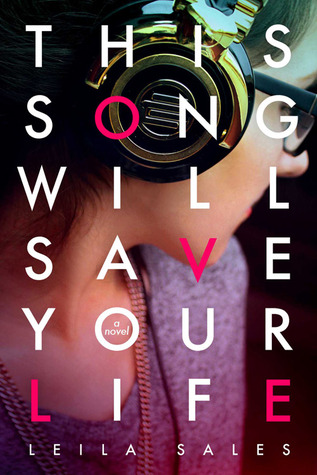
This Song Will Save Your Life - Leila Sales

Blurb:

Making friends has never been Elise Dembowski’s strong suit. All throughout her life, she’s been the butt of every joke and the outsider in every conversation. When a final attempt at popularity fails, Elise nearly gives up. Then she stumbles upon a warehouse party where she meets Vicky, a girl in a band who accepts her; Char, a cute, yet mysterious disc jockey; Pippa, a carefree spirit from England; and most importantly, a love for DJing.

Review:

Before I start I’d just like to say that this is a wonderful little book that you should definitely read , so if that’s the only recommendation you need then there is no need to read the rest of the review. If not, please carry on.


I picked up This Song Will Save Your Life randomly at the library purely because I liked the look of the cover, and the blurb looked vaguely interesting. I know that this is a habit I really need to break, but maybe it’s not that bad if it lead me to this fantastic book!


Elise, our protagonist, is definitely a character that a lot of readers will relate to, if only a little bit. She has a very strong voice and Sales easy to read writing style made Elise's story fly off the page. Elise is not only bullied, but seems to be completely ostricised by her peers. We are never really given a proper reason as to why Elise is bullied and excluded, which leads me to believe that there wasn’t a proper reason at all. Elise your typical I’m-just-doin’-me heroine, which I have absolutely no problem with, but that’s just how I would describe her. Elise may be different but only slightly different. I’ve seen a lot of these kind of people over the years, people who are just different enough not to fit in, to be pushed to the fringes. The other kids actively exclude Elise for no particular reason. This is probably the most accurate depiction of bullying of ever read. Normally kids who are bullied in novels are told that their tormentors are jealous or under-confident, and many other reasons, but in real life this rarely rings true. Some people are bullied simply because children, and people in general, can be very cruel.


However, Elise is by no means perfect. She is hell bent to criticise everyone and anyone she doesn’t get on with, and hates almost everything mainstream, music, fashion etc. Years of being bullied has put Elise on edge and sets her against almost everyone, even the people who care about her. Ironically enough, she spends a lot of time complaining about not being popular, and then criticises others for not reaching her standards hipster coolness. I cut Elise a bit of slack, because despite how judgemental she can be, she pales in comparison to how cruel some of her peers can be.


Sales also deals with the undefinable, un-understandable concept of popularity. Elise, who is quite pedantic, spends a lot of her time trying to figure out the rules to being popular, before figuring out that there are none. Sales expertly conveys popularity as a fluid, incomprehensible concept that we’ll never really fully understand. No one can put their finger on what makes one person popular and the other not, and Sales doesn’t provide any new insights. She even suggests the idea that popularity is what makes people mean, and once you remove that we’re just fine.


If you are a music fan, which you probably are if you’re reading a book called This Song Will Save Your Life, this is a fantastic book for you. The music plays a huge part in the narrative of the novel and gives us an insight into the characters and the atmosphere of the novel. It reminded me of The Perks of Being a Wallflower in that way. In my copy there was a list of songs in the back so I could look up the ones I didn’t already know.


This Song Will Save Your Life also has some unusual relationships. The contrast between Elises friendships with Vicky, Pippa, Sally, Chava, Harry and Amelia shows that friendships can come in many different forms, are never straight forward,  and just because someone isn’t your soulmate doesn’t mean you can’t be friends. Elise’s relationship with her little sister Alex is also extremely important to the story and one of my favourite parts in the book, showing me that we can sometimes be very misguided in doing what we think is best for the people we love. Elise’s relationship with Char is also very interesting. To me it was the opposite of the annoying teenage relationships found in most YA novels, and with this relationship Sales embraces all the holes that can be found in fictional young love. None of these relationships are cliched or over done, and I applaud Sales for her originality.


Overall I really excellent book, perfect for teenagers of all ages. I would really recommend it to anyone who enjoys contemporary young adult fiction.
Four Stars ****

Sunday, 24 August 2014

COMING SOON - Books I Can't Wait For


Vivian Versus America- Katie Coyle : I am beyond excited about the new Vivian Apple book due out the 4th of September 2014. It can't come fast enough. The first book was beyond beautiful and Viviann and Harp are my new heroes. I will get my hands on this book as soon as is humanly possible! I am absolutely loving the cover by the way. And the title, well, talk about controversial....


Echoes of Us- Kat Zhang : I just read What's Left of Me  and am currently on the hunt for a copy of Once We Were, (Side note, they're fantastic titles aren't they), but just because I'm not completely up to date with the series doesn't mean I'm not super looking forward to the final ( I think?) book in this series. God bless trilogies, God bless them one and all. Echoes of Us is out September 16th. Yay!!
Here's the link to my review of What's Left of Me.


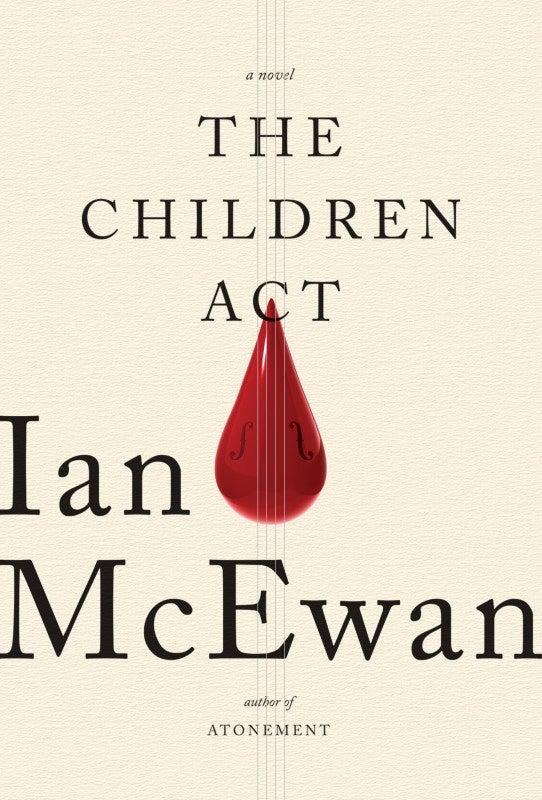
The Children Act - Ian McEwan: Being perfectly honest , I know nothing by about this book. Except that it's written by Ian McEwan. Whom I love, so that's enough for me. Can't wait to pick up a copy. Due out September 9th 2014.


Wednesday, 20 August 2014

Out of the Easy - Ruta Sepetys

Blurb: 

It’s 1950, and as the French Quarter of New Orleans simmers with secrets, seventeen-year-old Josie Moraine is silently stirring a pot of her own. Known among locals as the daughter of a brothel prostitute, Josie wants more out of life than the Big Easy has to offer. 

She devises a plan get out, but a mysterious death in the Quarter leaves Josie tangled in an investigation that will challenge her allegiance to her mother, her conscience, and Willie Woodley, the brusque madam on Conti Street. Josie is caught between the dream of an elite college and a clandestine underworld. New Orleans lures her in her quest for truth, dangling temptation at every turn, and escalating to the ultimate test


Review: 

Out of the Easy was probably one of the best books I have read in a long time. The minute I finished it, I immediately regretted the time I took Between Shades of Gray out of the library and returned it unread. Because Sepetys is a fantastic writer. A really really fantastic writer and I plan to read anything at all that woman writes, even the untitled book on goodreads that I know absolutely nothing about.


Out of the Easy may be set in New Orleans in the 1950’s , but it doesn’t feel like historical fiction. Out of the Easy is a story that happens to take place in the past, though it isn’t completely defined by it. After reading this book I’ve decided that the world needs more books that are set in New Orleans in the 1950’s.  I’ve been reading so many trilogies and series recently that when I finished this book, I just expected that there would be another one. But there isn’t , as far as I know, and this fact broke my heart a little. If there was any book I would want a sequel for, this is the one. Sepetys left me with so many questions, I want to find out what happened to so many characters, especially Josie.


Speaking of Josie, she is without doubt a worthy heroine. Josie is the daughter of a prostitute, she lives in a world of vice and immorality, and wants desperately to leave. She is fiercely independent and strong willed. Josie feels overwhelmingly uncomfortable in the world she lives in, and even though it would be easier to sink to everyone elses level of corruption, she shows her strength and stands up for what she believes in, no matter how tough things get. Josie always holds her own, despite being pushed by nearly everyone around her.


Josie isn’t the only interesting character in the book. Her mother, Louise, has to be one of the most despicable characters I’ve come across in a long time. She is a horrendous mother, and I’ll leave you to find out why. Though Josie seems to live in a morally corrupt world, she seems to surround herself with ( for the most part) good people. Willie, the brothel owner, was an especially interesting character. She is a strikingly strong woman, and even though she is involved in something as shady as prostitution, she still tries her best to support and care for those she loves, and retains her own moral code.


Another interesting aspect of the novel was the prejudice and hypocrisy that Josie encounters throughout the narrative. Most people who meet Josie look down on her because she is the daughter of a prostitute, and spends a lot of her time in the brothel. All of her classmates, bar Jesse , mock her because of her home life. Charlotte’s uncle, Mr. a-name-I-can’t-remember ( I gave the book back to the library), looks at Josie like she’s something nasty stuck to the bottom of his shoe, even though he himself employs prostitutes. Sepetys also centres on the theme of ( hmm.. how do I put this) self betterment, maybe. She uses David Copperfield, to do this. Josie, like Copperfield, wants to improve her situation and make a better future for herself than the one her mother provided for her.


This novel is one of the best I’ve read in a very long time, and in me Sepetys has found a new fan.  This may be historical fiction, but Josie’s story transcends time and becomes a book that Just happens to be set in the past. I would highly recommend this to anyone who like YA fiction.
Five Stars *****

Tuesday, 12 August 2014

A Possible Life - Sebastian Faulks


Blurb:

In Second World War Poland, a young prisoner closes his eyes and pictures going to bat on a sunlit English cricket ground.

Across the yard of a Victorian poorhouse, a man is too ashamed to acknowledge the son he gave away.

In a 19th-century French village, an old servant understands—suddenly and with awe—the meaning of the Bible story her master is reading to her.

On a summer evening in the Catskills in 1971, a skinny girl steps out of a Chevy with a guitar and with a song that will send shivers through her listeners' skulls.

A few years from now, in Italy, a gifted scientist discovers links between time and the human brain and between her lover's novel and his life.

Throughout the five masterpieces of fiction that make up A Possible Life, exquisitely drawn and unforgettable characters risk their bodies, hearts and minds in pursuit of the manna of human connection. Between soldier and lover, parent and child, servant and master, and artist and muse, important pleasures and pains are born of love, separations and missed opportunities. These interactions—whether successful or not—also affect the long trajectories of characters' lives.

Review: 

A Possible Life is the second book of Faulkes’ that I have read, the other being Birdsong, and it cemented the idea in me that, disregarding of content, his books are flawlessly written. His writing seems to effortlessly tread the line between ornate and easy to read. In this book, Faulkes does not use language simply for it’s own sake, but as a method of fluidly conveying his stories.


Before I go any further , I would like to point out that this is a book of five short stories. It is not a novel, which is what I presumed it to be, me and the rest of the world it seems. So if you don’t like short stories, don’t read it. Or maybe do. I am usually not a fan of the short story, maybe it was all those horrendous essays they made us read and write at school, but after a while I began to shiver at the sight of a short story. But after buying the book I thought I’d give it a lash, and I really enjoyed it. While they could be read separately, all five stories follow the same theme so you might as well read them in one go.


There are no dud stories in this book. All five have extremely interesting plots, all five span over quite a long period of time, covering a sizable chunk of the protagonists’ lives. Despite the variety and range of the stories and settings, each one contains definite characters, each with their own unique voice. Without doubt my favorite story was the last one, but that’s just personal preference. Objectively each was as good as the next.


The theme of the book is the randomness of life and love and everything that is tied together with it. Sounds deep right? It was so deep I’m not sure if I really understood it. As far as I can tell Faulkes explores the nature of life, and what makes us human. The back of my book says he explores ‘the chaos created by love, separation and missed opportunities’ , and that seems about right to me so I’ll use that. There is an extremely interesting story about an Italian scientist , set the future, who tries to discover what it is that gives us our humanity. Whether or not it is scientifically accurate, if it is Faulkes’ mad musings, the theory is either terrifying or magnificent, depending on how you value science.


In conclusion, this is a pretty good collection of short stories, which may or may not be extremely deep and perceptive ( I couldn’t tell ), written extremely well.

Four Stars.

Thursday, 31 July 2014

All These Things I've Done - Gabrielle Zevin (#1 Birthright Trilogy)


Blurb:

In 2083, chocolate and coffee are illegal, paper is hard to find, water is carefully rationed, and New York City is rife with crime and poverty. And yet, for Anya Balanchine, the sixteen-year-old daughter of the city's most notorious (and dead) crime boss, life is fairly routine. It consists of going to school, taking care of her siblings and her dying grandmother, trying to avoid falling in love with the new assistant D.A.'s son, and avoiding her loser ex-boyfriend. That is until her ex is accidently poisoned by the chocolate her family manufactures and the police think she's to blame. Suddenly, Anya finds herself thrust unwillingly into the spotlight--at school, in the news, and most importantly, within her mafia family.

Review: 

All These Things I’ve Done  is the first book in the Birthright trilogy. The series follows Anya Balanchine, the daughter of a mob boss, and is set in New York in 2083. Anya lives with with her aged grandmother, her older brother and younger sister, and even though she is only sixteen she is effectively head of her household.


The big seller in the blurb of this book is the idea that Anya is framed for attempted murder, something that I thought sounded quite exciting, but I wouldn’t hold your breath if I were you. It doesn’t happen for ages, probably about a thirds of the book in, so it’s hardly the catalyst of the plot. And on top of that, it’s a pretty tame attempted murder, so that was kind of disappointing.
The other aspect played up in the blurb was the love story between Anya and the DA’s son, Win. I got the impression that Anya and Win were going to be star crossed lovers from different sides of the tracks, but it’s not really as exciting as that. Both Win and Anya attend the same elite Catholic private school, both Anya and Win come from quite affluent backgrounds, even though their money has been earned by very different means. Win’s father is the the New York district attorney’s second in command, and because he fears his son’s relationship with a member of the Balanchine family will affect his reputation and candidacy for DA, he forbids them from seeing each other. ( I wouldn’t consider this a spoiler because it was basically written in less detail in the blurb, but it doesn’t happen until quite a while into the story.) While this extremely cliched, at least Zevin mixed it up a bit and made the girl from the wrong side of the tracks.


However, in the end the romance wasn’t even the most important part of the story. Zevin has created an interesting, futuristic, sort-of-dystopian world. New York has turned into a crumbling city fuelled by crime and corruption. In her world Zevin has placed a prohibition on caffeine and chocolate. I couldn’t see any reason for this ban , except to demoralise the civilians, but not one on alcohol, which doesn’t seem to be a problem in Zevin’s New York. Because of this ban , there is a black market trade in chocolate which Anya’s criminal relatives, the Balanchines, are involved in. Severe rationing has been put on fundamental things such as water and paper, no new clothes or books are made, and all types of food are in short supply. Ayna and her sister attend a super elite Catholic private school, which seems completely out of place in this Gotham-style New York.  Even though the book is set in 2083, Anya still lives in a patriarchal society. The men in the Balanchine family are irrefutably in charge, and when Anya’s father, the head of the organisation, is killed , Anya’s grandmother is passed over for the top spot. Similarly, they refuse to work with Anya, purely because she is a girl.


Zevin uses Anya’s grandmother in a very interesting way to reflect our time. She was born in 1995, probably the same year the average reader of this book was born. She reminisces back to now, and I found it extremely odd to hear the characters talk about our time as if it were history.


Anya is not the usual YA heroine. Normally the female protagonists are simpering damsels in distress, or mouthy crazy free-spirits. Fortunately, Anya follows in the footsteps of characters such as Katniss and Tris, and manages not to be a complete pain in the ass. Anya’s faith is very important to her, surprisingly enough. Normally religion is left completely out of these futuristic dystopian novels, but Anya is a staunch Catholic and a lot of her choices and actions are based on her faith. While I was impressed by Anya, I was not by Win. Win reminded me of a smarmy Augustus Waters, but ten times worse. If you have a hard time stomaching Augustus, you will have an even worse time trying to put up with Win. Normally the male protagonist s in YA novels are easy to drool over, but Win, for want of a better word, was kind of meh.


Overall a good, futuristic, dystopian novel and I’m looking forward to the next one and seeing where Anya and her family end up.  I would recommend this to anyone who like good quality YA dystopian, and it reminded me a bit of Divergent.

Stars: 3 ½ stars

Friday, 25 July 2014

Norwegian Wood - Haruki Murakami

Blurb:

Toru, a quiet and preternaturally serious young college student in Tokyo, is devoted to Naoko, a beautiful and introspective young woman, but their mutual passion is marked by the tragic death of their best friend years before.  Toru begins to adapt to campus life and the loneliness and isolation he faces there, but Naoko finds the pressures and responsibilities of life unbearable.  As she retreats further into her own world, Toru finds himself reaching out to others and drawn to a fiercely independent and sexually liberated young woman.

A poignant story of one college student's romantic coming-of-age,Norwegian Wood takes us to that distant place of a young man's first, hopeless, and heroic love.


Review: 

There is a lot to be said about Norwegian Wood. It’s a coming of age story, or to use the pretentious new word I’ve learned, a bildungsroman. Norwegian Wood is apparently Murakami’s most popular novel, even though it is extremely different to his other novels. The narrative follows Toru Watanabe through his first years of university as he learns about the nature of life and death.


Norwegian Wood is permeated by a sense of loneliness and alienation. Our protagonist, Watanabe, embodies this loneliness. I found Watanabe to be kind of an annoying character to begin with, his defining feature is his loneliness and isolation from those around him. He is, in my opinion, a terribly dull character. But Watanabe is like this for a good reason, and his nature serves an extremely plot and symbolic point. So as boring as I found Watanabe, maybe he was just representative of a more normal person, instead of the caricatures we sometimes find in novels.


The more I read of this book, the more I thought of it as an older, darker, harsher, more graphic version of a John Green novel. It reminded me so much of Green’s first novel, Looking for Alaska, it almost seemed to a darker version for older young adults. Don’t feel like I’ve spoiled it for you , the plot of Norwegian Wood is nothing like that of Looking for Alaska, but there were definitely some parallels. The characters of Watanabe and Midori are extremely like Pudge and Alaska. The arc and tone of the story was quite similar, and just like Pudge, throughout the novel Watanabe comes to understand the nature of life and death. ( Just to let you know , I loved Looking for Alaska ,  so I did not mind reading another book I found similar to it. The similarities aren’t bad, I just wanted to point them. Also, I’m pretty sure Norwegian Wood was written first, so if anyone is copying, it’s Green.)As I’ve mentioned before, this novel is surprisingly dark. Murakami deals with suicide and mental illness in his novel, and no holds are barred.


The characters, for the most part, are fairly realistic. Naoko, Watanabe’s best friends ex-girlfriend seems to be a rather quiet, rather lost character. Nagasawa, Watanabe’s friend, is an intellectual player who is unable to commit. Reiko, Naoko’s middle aged roommate, is probably the oddest of the characters, while still managing to be realistic. Midori, on the other hand, seemed to be one of those cliched whirlwind, crazy girls that you rarely meet in real life.


Overall this was a really good book. I didn’t love it like everyone else seemed to , but I did really really like it. I would recommended it to anyone who wants to make a step up from ordinary YA novels.

4 Stars

Wednesday, 23 July 2014

What's Left of Me - Kat Zhang


Blurb: I should not exist. But I do.

Eva and Addie started out the same way as everyone else—two souls woven together in one body, taking turns controlling their movements as they learned how to walk, how to sing, how to dance. But as they grew, so did the worried whispers. Why aren’t they settling? Why isn’t one of them fading? The doctors ran tests, the neighbors shied away, and their parents begged for more time. Finally Addie was pronounced healthy and Eva was declared gone. Except, she wasn’t . . .

For the past three years, Eva has clung to the remnants of her life. Only Addie knows she’s still there, trapped inside their body. Then one day, they discover there may be a way for Eva to move again. The risks are unimaginable-hybrids are considered a threat to society, so if they are caught, Addie and Eva will be locked away with the others. And yet . . . for a chance to smile, to twirl, to speak, Eva will do anything.


Review: 

The novel opens with the extremely interesting premise that each human is born with two souls instead of one, two consciousnesses that coexist in harmony until one of them, the dominant soul, eclipses the other, the recessive soul . Except in the case of Addie and Eva,our protagonists, the recessive soul, Eva,  never disappears. Addie and Eva still share the same body years after all their peers have lost their recessive soul.  People like this are called hybrids and they are thought to be dangerous by most of society. They live in fear of being discovered and being separated. The society that Eva and Addie live in is almost identical to our own, and this gave the book a slightly unnerving quality.

The book is told from Eva’s perspective, even though Addie is in control of their body. The dual souls idea  is kind of confusing to begin with, but I got used to it after a while. Zhang makes the distinction between Addie and Eva quite clear, but I found it difficult to distinguish between the other characters. To me they didn’t have a unique voice.

This is quite a page turner, and I was interested to see how the book ended the whole way through. Even though I found the characters a little dull, the plot was extremely engaging. l didn’t realise that this was the first book of a series when I first picked up the book, and I would definitely keep an eye out for the next one. I’m interested to see where the story goes from here, and there are an awful lot of questions I would like to be answered. Like how did the hybrids come to be, or do they just live in an alternate universe where people have always had two souls. Why did society came to fear and ostricise hybrids , even though in the other countries around the world hybrids are in the majority.

This book is a pretty solid dystopian thriller, definitely one of the better ones I have read (the standard in this genre is definitely slipping)

3 Stars