Wednesday, 12 November 2014

Infinite Sky - C.J. Flood

Publisher: 1/6/2013
Published: Simon and Schuster UK

Blurb: 

When Iris' mum leaves home, her brother, Sam, goes off the rails and her dad is left trying to hold it all together. So when a family of travellers sets up camp illegally in front of their farm, its the catalyst for a stand-off that can only end in disaster. But to Iris it's an adventure. She secretly strikes up a friendship with the gypsy boy, Trick, and discovers home can be something as simple as a carved out circle in a field of corn... 

Review:

I had heard so much about Infinite Sky from numerous different booktubers, so I was delighted when I managed to pick up a copy up from the library. In her novel, Flood deals with Irish travellers in a very unusual way. As the story begins travellers move into the field beside beside our protagonist Iris’ house, just as her mother moves away, and her life is never the same again.


One of the strongest and most interesting aspects of the novel is the broad range of characters presented by Flood. None of the characters conform to our preconceived ideas of these characters. Iris is a pretty unique protagonist. I would consider this a YA novel, but Iris is not the typical age of a YA protagonist. Iris is about fourteen or fifteen, and she greatly reminded me of Melon, the protagonist in Red Ink by Julie Mayhew. Except that Iris is a bit of a flat character, without the individuality and unique voice that made me love Melon


The book begins with the excellent premise that someone Iris loves is going to be killed by someone else she loves. Now I don’t know about you, but this was enough to hook me. This prologue kept me intrigued all the way thought the book until the actual event, even if I had figured out what would happen long before it did. Conversely, I’m not sure if the plot would have been enough to hold my attention without this bombshell at the beginning. It kind of moseys along before picking up right before the very end, so I’m glad I stuck it out, but I can’t help but feel that Flood told us the end to keep us interested, you know… like the way the do in Revenge.


The plot of this novel reflects real life as there is undeniable and destructive tension between Iris’ family and the travellers that move into the field beside their house. The travellers do not live up to society’s expectations of them, and turn out to be pretty decent people. More decent, in fact, than Iris’ own family. As Iris’ friendship with Trick grows , she becomes more and more torn between her loyalty to and love for her family and her disgust for their actions. Iris is so young and it was quite painful to watch her agonise over this very serious issue that no young girl should have to deal with.


Travellers are presented in quite an open minded and unbiased way in this novel. As I sort of grew up with travellers and went to school with quite a few I was extremely familiar with traveller culture, so while the way travellers are presented in the novel is different to the way they usually are in the media, I wasn’t too surprised. I imagine it would be a hugely enlightening read if you were unfamiliar with traveler culture , and it will definitely open your mind to this group of people.


There are a few interesting characters in this novel including Sam, Iris’ brother , Iris’ mother and Iris’ best friend (Mattie? I think, I’m going to go with Mattie, I didn’t write her name in my notes and it’s been a while… ). Sam is definitely an interesting character, but not a likeable character. He had the potential to be likeable, when Iris reminisces back to the time before her mother left we see glimpses of a much better Sam. He is definitely the most complex character and my feelings for him fluctuated between feeling sorry for him and being truly aggravated by him. Iris’ mother is also pretty interesting. To me, she embodies the debate whether or not a parent’s primary responsibility is to their children, and how much can parents let a broken marriage affect the children of the relationship. Iris’ best friend Mattie (correct me if I’m wrong) is a massive pain in the ass, and reminded me of Chick from Red Ink ( again ), so watch out for her.


Overall this was a pretty solid novel and it was no chore to read it. Objectively it was really good, but for some reason it didn’t click with me. I would definitely recommend it to anyone who who enjoys YA contemporary with a bit of bite and doesn’t mind shedding a few tears.
Objectively : Four Stars ****
Personally : Three and a half stars

Wednesday, 5 November 2014

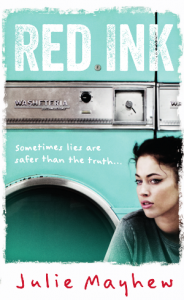
Red Ink - Julie Mayhew

Blurb: 

When her mother is knocked down and killed by a London bus, fifteen-year-old Melon Fouraki is left with no family worth mentioning. Her mother, Maria, never did introduce Melon to a 'living, breathing' father. The indomitable Auntie Aphrodite, meanwhile, is hundreds of miles away on a farm in Crete, and is unlikely to be jumping on a plane and coming to East Finchley anytime soon. But at least Melon has 'The Story'. 'The Story' is the Fourakis family fairytale. A story is something. RED INK is a powerful coming-of-age tale about superstition, denial and family myth.

Review: 

I picked up a copy of Red Ink by Julie Mayhew in the library after it was recommended to me by a friend. This isn’t a very high profile book. It was sent to my friend, who also writes a book blog, by Hot Key books , and she couldn’t give it more praise. And after reading it neither could I. I didn’t know what I was getting into with Red Ink, and I could not expect the effect it would have on me. It is without a doubt the best contemporary YA novel I have ever read.


The novel follows Melon, a fourteen/ fifteen year old girl in the time leading up to and after her mother’s sudden and unexpected death. The novel is definitely a coming of age story, and Melon under gos some of the best character development I’ve ever read in a YA contemporary novel. Melon begins the novel as a child, and by the time it ends she is a young woman. Melon develops and grows so much over the course of the novel, and it seems very intimate to see her become a strong, independent, wise, young woman. I identified quite a bit with Melon. Although she was younger then me , we have the same dark, cynical sense of humour and the same insecurities. She is without a doubt one of my favourite characters , not because she reminds me of myself, but because she is so real. She isn't one of those martyred YA heroines, who is perfect except for their insecurities about their height or weight, who is actually so pretty when some boy tells her to take her glasses off. Melon is strong and flawed, and I am so full of admiration for her resilience but also her reliance. Melon felt like if she were real, we would be best friends, and what more could you want in a protagonist.


There are a few very interesting relationships in this novel, the first being Melon’s relationship with her best friend Chuck. In a nutshell, Melon’s mother doesn’t approve of her relationship, and Melon can’t really figure out why, but it becomes apparent before long. An even more interesting relationship is that of Melon and her mother’s boyfriend Paul. Everyone is surprised by this particular relationship, the social workers are suspicious and even Melon doesn’t understand it. But Melon and Paul are family, even if they are an odd sort of family, and through them Mayhew effectively conveys the idea that family comes in all shapes and sizes.


The central theme in this book is loss of innocence and the idea that both Melon and her mother Maria grow up too quickly. It was quite difficult to watch Melon’s childhood be taken away from her because of her mother’s death, and the same goes for her mother when she falls pregnant with Melon at the age of fourteen. The novel also, obviously enough, deals with the theme of death and how we come to terms with the death of a loved one. This is one of the most accurate depictions of grief and loss I’ve ever read, and I felt a deep sense of sympathy with Melon as she struggles to come to terms with her mothers death.  


The story has an intentional and very effective fairytale quality which I absolutely loved. The narrative is punctuated by the story ( The Story ) Maria tells Melon, about her childhood in Greece, Melon’s father and how Maria came to London. The story is told in third person and narrated like a fairytale, which gave it a mysterious quality which greatly contrasted with the gritty realism of the rest of the novel. Through this “fairy tale”, Mayhew deals with the idea of truth, and how we bend and manipulate it in order to protect our loved ones, ( I hope that’s not a spoiler).


Red Ink also deals with the highly controversial and current topic of body image. It is safe to say that Melon, like most teenage girls, does not have a positive body image. She constantly compares herself to her mother and her peers, something we are told not to do, but we do it anyway. One of the best extracts of prose I have ever read about this topic was in this novel. It was when Melon ( and Mayhew of course ) finally put into words what I had felt all through my teen years. We know it is unhealthy to pick out flaws in ourselves, and unkind to do do in others. But we can’t help ourselves and sometimes the only way to feel better about our flat chest or big thighs is to pick out and criticise someone elses frizzy hair or muffin top. It’s not good, but it is a part of the teenage mindset, and I feel Mayhew really hit the nail on the head in this paragraph. (It’s p.169 if you have the same copy as me.)


I have a few tiny problems to pedantically complain about for a second. The novel is very slow to begin with, and it didn’t hold my attention to begin with. It took me a good few tries to settle into it. Similarly, the plot is told in a non linear fashion, flashing backward and forward around the death of Melon’s mother. I found that this made it very difficult to follow the plot, especially because Melon’s character changes so much over the course of the story that it sometimes felt that there were two different characters narrating.


Overall, a thoroughly enjoyable and thought provoking read and I highly recommend it to lovers of YA contemporary books. You will not regret reading this!!

Five Stars *****

Wednesday, 29 October 2014

Where She Went - Gayle Foreman ( #2 If I Stay)

Blurb:

It's been three years since the devastating accident . . . three years since Mia walked out of Adam's life forever.

Now living on opposite coasts, Mia is Juilliard's rising star and Adam is LA tabloid fodder, thanks to his new rock star status and celebrity girlfriend. When Adam gets stuck in New York by himself, chance brings the couple together again, for one last night. As they explore the city that has become Mia's home, Adam and Mia revisit the past and open their hearts to the future-and each other.

Told from Adam's point of view in the spare, lyrical prose that defined If I Stay, Where She Went explores the devastation of grief, the promise of new hope, and the flame of rekindled romance.

Review:

I was pulled back to Where She Went by the new film made out of it’s predecessor, If I Stay. This review will obviously contain some If I Stay spoilers, as it would be hard to talk about it’s sequel without mentioning them. If you haven’t read If I Stay stop reading now !!


We take up the story with the surprising revelation that Adam and Mia broke up a few years ago, and the story is told from Adam’s point of view. Unlike other stories with multiple points of views, Adam’s voice is extremely clear and different to Mia’s, who narrated the first book. It was also extremely interesting to hear Adam’s side of the story, to hear about the accident that killed Mia’s family from a different perspective. The plot centres mostly around Adam and Mia , with a few minor side characters, and this makes the plot very easy to follow.


In this book , Foreman explores how grief affects those left behind and their relationships. As  difficult as it was for Mia to stay after the accident, her real trial begins as her life resumes. As the narrative progresses, we discover how both Mia’s grief and how she is treated by Adam contributes to the demise of their relationship.


The narrative unfolds over the course of a day , with flashbacks to the time between the accident and the present day. Foreman uses this technique very well, and I wasn’t at all confused or disorientated by it. The book is quite a short, easy read , and I read it in one sitting on the train when I should have been studying.


One of the aspects I found really interesting was that of the comparison between Adam and Mia’s careers in the music industry. Adam is a fully established lead man in an international rock band, and Mia is a rising star cellist finishing up in Julliard and beginning to play proper recitals. Their outlooks and dispositions towards their work and music are extremely different. Mia still plays for her love of the music, and credits her recovery from the accident to the cello, while Adam’s love of his craft has been ruined by the media circus surrounding his band’ meteoric rise to fame. The media and fame have sucked the love out of music, interviewers talk about everything but it. The media has singled out Adam as the most interesting member of the band, and now focus all their attention on his, causing tension within the band.


There’s not a whole lot to say about this book except that if you liked the first one, you will definitely enjoy hearing what happened to Adam and Mia next. It’s an easy, slightly tear-jerking  read with pleasant characters , and I would recommend it to anyone who enjoys young adult contemporary fiction or the movie !!!


Three Stars ***

Wednesday, 22 October 2014

The Maze Runner - James Dashner ( The Maze Runner #1 )

Blurb:

If you ain’t scared, you ain’t human.
When Thomas wakes up in the lift, the only thing he can remember is his name. He’s surrounded by strangers—boys whose memories are also gone.
Nice to meet ya, shank. Welcome to the Glade.
Outside the towering stone walls that surround the Glade is a limitless, ever-changing maze. It’s the only way out—and no one’s ever made it through alive.
Everything is going to change.
Then a girl arrives. The first girl ever. And the message she delivers is terrifying.
Remember. Survive. Run.


Review: 

This book was first recommended to me by my cousin about three years ago, and it has taken me until now to read it. I will shamelessly admit that I totally disregarded the original recommendation. “It’s about these boys”, my cousin told me, “ and they’re stuck in a maze.” It sounded awful, and I decided never to read it. I only picked it up now because I saw the movie trailer, and it made the plot sound a lot more exciting and a lot less ridiculous than I thought it would be.


With that said, the premise is ridiculous, like a nonsensical nightmare. When Thomas wakes up in the glade, in the middle of a giant maze that moves at night, he cannot remember anything except his name. If you can suspend your disbelief , please do , it is worth it in the long hall.


The first half of the book is slow. Dashner builds the world of the glade and the maze, and introduces us to a crop of new characters. Much like in Lord of the Flies, I found it very difficult to remember the names of the adolescent boys, but I’m pretty sure that this is my own fault not Dashner’s. I am really awful with names. Thomas spends the first half of the book running around feeling lost and sorry for himself, understandably, and the others spend their time making fun of him. I found this half of the book quite tedious and the pacing was very slow. I had to force myself to read it sometimes, but I was glad I persevered.


The book picks up pace in the second half and becomes quite gripping. By the end of the narrative I was left reeling from the information overload dumped upon the reader in the final chapter. This novel definitely poses more questions than it answers and I feel like I’ll definitely have to read on to find out more about why the boys are in the Maze, and about Thomas and Teresa’s life before the Maze.


A huge feature of the novel is the glader’s slang, which got on my nerves sometimes. I took it to be a representation the boys’ isolation, they have no contact with the outside world so they invent their own dialect. But even if this was Dashner’s intention, I found that the only thing it succeeded in doing was breaking up the dialogue and leaving me confused as to what they were trying to say. And he was using it as a way to sneak curse words into a middle grade novel, he would have been better off without them at all. The characters were a bit bland in my opinion, my favourite being Minho, but apart from that they were all just a bit boring.

*****SORT OF SPOILER: The bit at the end that Dashner clearly put in just to tug at our heart strings didn't really feel developed enough to actually upset me, and it's very easy to make me cry. If it was supposed to give Thomas a reason to keep fighting, I feel like trying to find out why you had your memory wiped before being put in a maze that tries to kill you is reason enough. ******


This book is routinely compared to The Hunger Games , but in my opinion  The Maze Runner isn’t a patch on them. Maybe I have to give it more of a chance, but I’m not too optimistic about it. I am definitely still going to go see the movie, I’m looking forward to seeing how the book is translated to the big screen and I’ve heard  some really good reviews. I feel like I’m a little too old for this book, and if I had read it three years ago when it was originally recommended to me I would have like it more. I would recommend it to teenagers between the ages of 12 and 17, especially to those who enjoyed books like Divergent and The Hunger Games.
Three Stars ***

Wednesday, 15 October 2014

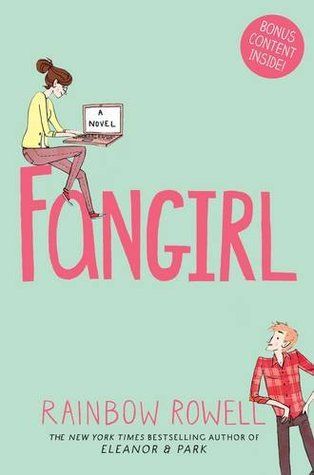
Fangirl - Rainbow Rowell

Blurb:

Cath is a Simon Snow fan.
Okay, the whole world is a Simon Snow fan...
But for Cath, being a fan is her life—and she’s really good at it. She and her twin sister, Wren, ensconced themselves in the Simon Snow series when they were just kids; it’s what got them through their mother leaving.
Reading. Rereading. Hanging out in Simon Snow forums, writing Simon Snow fan fiction, dressing up like the characters for every movie premiere.
Cath’s sister has mostly grown away from fandom, but Cath can’t let go. She doesn’t want to.
Now that they’re going to college, Wren has told Cath she doesn’t want to be roommates. Cath is on her own, completely outside of her comfort zone. She’s got a surly roommate with a charming, always-around boyfriend, a fiction-writing professor who thinks fan fiction is the end of the civilized world, a handsome classmate who only wants to talk about words... And she can’t stop worrying about her dad, who’s loving and fragile and has never really been alone.
For Cath, the question is: Can she do this?
Can she make it without Wren holding her hand? Is she ready to start living her own life? Writing her own stories?

And does she even want to move on if it means leaving Simon Snow behind?


Review: 

I had heard so much about this book before I finally picked up a copy. People are raving about it all over booktube, and I finally succumbed to the pressure and bought a copy. It’s safe to say I wasn’t disappointed. I loved this book so much. It was a real binge read, I just couldn’t put it down.


One of the main reasons I love this book is because of the role Simon Snow plays in the novel. Simon Snow is this worlds Harry Potter. Simon Snow is a boy magician who attends a magic school. Gemma T. Leslie has written eight books following Simon Snow’s adventures ( it’s not fair that they get eight, and we only got seven) and movie adaptations have been made of the series. Simon Snow is obviously not as good as Harry Potter, but it mirrors the HP fandom in many ways. Cath, our protagonist, writes a Simon Snow fanfiction in which Simon and his nemesis Baz are a couple, which I loved. It reminded me of all the ridiculous ships in contemporary fandoms (eg. Johnlock from BBC’s Sherlock). Simon and Baz clearly hate each other in the novel, similarly to Harry and Malfoy, but Cath is convinced they are in love. I also loved that even though Wren, Cath’s twin sister, is the epitome of coolness, she remains a big Simon Snow fan to the very end. Cath and Wren grew up with Simon Snow, and it remains a huge part of their lives even as they go to college. This is a concept many of us can identify with: the connection that the girls feel to the series, the part it played in their lives, and their sadness as it ends.


The characters in this book are fantastic. In my opinion they had a lot more depth to them than characters usually have in YA fiction. I found that Cath is one of the most relatable characters I have read in a long time. Even though Cath is quite introverted and shy, she’s not painted socially inept like so many quiet characters are in YA fiction. Levi and Nick, the love interests in the novel, also don’t conform to the stereotype of the YA love interest. Wren’s main characteristic may be her desire to party, but there is a lot more to her than that. The girls relationship with their mother was quite interesting and kind of upsetting, but I didn’t think it added that much to the main plot. It was interesting to see how the twins reacted differently to their mother’s actions, which were questionable at best. Regan, however, was my favourite character by far. She is just so no-nonsense, I finished the book feeling that everyone should have a friend like Regan. The complexity and non-conformity of these characters teach an important lesson. People are extremely difficult to define and put in boxes, and we shouldn’t try to.


The plotline in this novel was quite unusual. I was under this impression that this would be a romance, but the storylines revolving around Cath’s family and personal development were nearly more important than her romantic endeavors. I found it quite refreshing that her relationships are not the key ingredient to her happiness like they are in so many novels, but more of a happy bonus. This book is definitely more of a coming of age story than a romance, and it was wonderful to watch Cath grow and develop in front of my eyes.


Another aspect of the plot was Cath’s struggle when it came to her fiction writing course. She is clearly very talented as she gets into a Sophomore (I think) fiction writing class , and very experienced (her Simon Snow fanfiction is three times the length of a normal Simon Snow novel and she has an international following). But Cath still struggles with fiction writing and finds safety and comfort borrowing from Gemma T. Leslie. Fangirl also raises some questions with regards to the legitimacy of fanfiction, which were very interesting to think about , especially in the light of the Cassandra Clare fanfiction “scandal”.  


Overall I loved this book. It was quite quirky and honest, and I really related to Cath and her situation, especially as a freshman in college. I would recommend this to anyone who likes YA contemporary fiction. It’s an easy, quick and thoroughly worthwhile read.
Four and a half stars

Wednesday, 8 October 2014

Behind the Beautiful Forevers - Katherine Boo

Blurb: 

From Pulitzer Prize-winner Katherine Boo, a landmark work of narrative nonfiction that tells the dramatic and sometimes heartbreaking story of families striving toward a better life in one of the twenty-first century’s great, unequal cities.

In this brilliantly written, fast-paced book, based on three years of uncompromising reporting, a bewildering age of global change and inequality is made human.

Annawadi is a makeshift settlement in the shadow of luxury hotels near the Mumbai airport, and as India starts to prosper, Annawadians are electric with hope. Abdul, a reflective and enterprising Muslim teenager, sees “a fortune beyond counting“ in the recyclable garbage that richer people throw away. Asha, a woman of formidable wit and deep scars from a childhood in rural poverty, has identified an alternate route to the middle class: political corruption. With a little luck, her sensitive, beautiful daughter — Annawadi's "most-everything girl" — will soon become its first female college graduate. And even the poorest Annawadians, like Kalu, a fifteen-year-old scrap-metal thief, believe themselves inching closer to the good lives and good times they call “the full enjoy.”

But then Abdul the garbage sorter is falsely accused in a shocking tragedy; terror and a global recession rock the city; and suppressed tensions over religion, caste, sex, power and economic envy turn brutal. As the tenderest individual hopes intersect with the greatest global truths, the true contours of a competitive age are revealed. And so, too, are the imaginations and courage of the people of Annawadi.

With intelligence, humor, and deep insight into what connects human beings to one another in an era of tumultuous change, Behind the Beautiful Forevers carries the reader headlong into one of the twenty-first century’s hidden worlds, and into the lives of people impossible to forget.


Review: 

There is so much to say about Behind the Beautiful Forevers that all I’m going to be able to do in this review is skim over everything I’d like to talk about. This is the second world-view-defining book I’ve read in the past week or so ( the first being Things Fall Apart by Chinua Achebe), but lets just say BtBF affected me in this way much more than any other book I’ve read. Behind the Beautiful Forevers is astoundingly complex, and I wouldn’t expect any easy or straightforward answers about any of the issues Boo raises in this book.


Before you read this book, I’ll tell you about a game you can play. Take a shot every time Boo mentions bribery. You will be plastered, there is that much corruption. The justice system and the police are a joke in Annawadi. Everything can be sorted with a bribe, and nothing can be done without one. Both systems are fuelled by ‘favours’ and brown envelopes. But corruption is not that simple in this novel. Many of the characters use it to better their financial and societal situations. Documents are forged, bribes are given, votes are bought and denied, charitable funds are received and misdirected into pockets rather than schools or other public works projects. Even though surgical procedures were supposed to be free, most doctors still charged under the table fees for them. One of the other surprising things was how the slum dwellers manipulate the “white guilt” of the western charity workers to do better for themselves. It kind of made me more cynical and suspicious of charitable organisations. I always thought that these organisations were corruption free, but it turns out you have to be careful with who you give your money to to make sure it goes where you want it to go. (Just to make it clear, this didn’t put me off donating to charities in India, it would just make me more discerning when it comes which charity I would donate to.) This was one of the things that upset me the most in this novel, that in order to survive in Annawadi, you cannot  be honourable.


Living in the west, we are usually presented with the poor in places like India as a faceless monolith of the hopeless. But the poor in BtBF are presented much more complexly by Boo. Instead of an indiscriminate mass of poverty, we see single, complex individuals. Despite the fact they are all poor, the society in Annawadi is divided by religion and status. Technically, everyone living in Annawadi lives above the poverty line ( which is $1.25 a day I think) but some have a lot more money than others. Characters like Asha live quite comfortably, she can afford to send her daughter to college, and has a job as a kindergarten teacher. If you compare her situation to Sunil, a young garbage collector, she lives like a queen. Sunil is so hungry all the time that he takes up smoking old cigarette butts to curb the hunger pains and his growth has been stunted after years of starvation. Even though both Asha and Sunil are thrown together in the western view of poverty in India, but both lead astoundingly different lives. Boo also deals with the idea that maybe we need the poor to stay poor in order to stay rich. Abdul’s brother (I think) has a fantastic line that goes something like “Everything around us is roses, and we’re the shit in between”, the implication of this is that the rich of Mumbai, and maybe the rest of the world, can only survive while the poor stay poor, that the roses must be fertilised by something in order to stay beautiful and alive. BtBF gave me a whole new, much needed perspective on poverty, and I would really recommend this to anyone interested in humanitarian relief.
The other concept Boo addresses in this novel is how luck shapes our lives. I don’t want to spoil anything by giving too many examples, but the book opens with Abdul’s family being accused of a crime they didn’t commit, which causes ructions in their lives. Using this example , and many others , Boo explores the idea that no matter how hard you work or what you achieve, your life can still be turned upside down by something completely beyond your control. Which is upsetting, but it’s something we need to hear and understand.


Humanitarian organisations always tell us that education is the way out of poverty, and that more education should be made available in countries like India. But the thing is, there is plenty of education available in Annawadi , but it is of such poor quality it is of very little use. Asha’s daughter Manju attends a college where you can pass be essentially learning-off summaries of books. This same teenaged girl teaches the slum children in a kind of semi-official charity funded school, where the children learn next to nothing. This made me re-evaluate my whole opinion that the way to help the poor in India is to provide education, because clearly this is not working.


Overall this is a fantastic plot. If I had to compare it to anything I’d say it’s a bit like A Casual Vacancy by J.K. Rowling. It’s very character driven, with one pivotal plot point. I wouldn’t recommend this to anyone who doesn’t like quite harsh, adult fiction. If you’re a fan of YA fiction, then I would recommend that you read this. You may not enjoy it as much as I did, but it’s one of those must-read, world-view-changing books that you will remember long after you finish it.


Four and a half Stars

Wednesday, 1 October 2014

Because it is My Blood - Gabrielle Zevin (#2 Birthright Trilogy)

Blurb:

Freed from jail, Anya hopes that things will get back to normal. But life on the outside is even more dangerous than life behind bars. Some of her gangland family want revenge for the crime for which she has done time: the shooting of her uncle. Forced to flee the country, Anya hides out in a cacao plantation in Mexico. There she learns the secrets of the chocolate trade, a trade that is illegal and deadly in her native New York. There too she discovers that seemingly random acts of violence carried out across the world have a single target: her family. As innocent bystanders get caught in the crossfire Anya must act fast and decisively to stop it, no matter what the danger to herself.

Review:

This is the second book in the Blood Ties trilogy, and before I start I’ll tell you that you really need to read the first one before you start this. Click here to read my review of All These Things I've Done.


There’s nothing more really to be said about the world Zevin created, I’ve dealt with all of that in the first review. But in this one Zevin does go into more detail about why chocolate has been banned, which I really wanted to know. The whole chocolate prohibition is quite interesting and reflective of the world Anya lives in, but I won’t spoil it with the details.


In this novel, Zevin continues to mock our present-day culture. All the grandparents in this book were born around the same time as me, so it’s weird to think that there will be a time after this when people will look at our culture and think that we were bonkers. There’s a beautiful Twilight reference that just blows a hole in our current obsession with vampires. Through this Zevin gives us a wonderful perspective on our culture, and I just hope she takes a shot at our growing fascination with dystopian fiction in her next book. There’s nothing like a bit of self parody, I always say.


Just as I mentioned in the last review, the blurb on the back of my copy of this book is equally misleading. I’d like to ask the person who writes the blurbs why they can’t just put actual events from the plot on the back of the book. The one I found on Goodreads however was a better representation of plot, so I've used that instead.


Finally to address the characters. Win is just as annoying as ever, ( especially at the end)but maybe because I’m not in love with him like Anya is I just find it more difficult to overlook his flaws. Gable continues to be a tool , and Scarlet turned into kind of a disappointment to both me and Anya because of a decision she makes towards the end of the book. Also mouse makes another appearance and grows quite a bit as a character, but  there is still no mention of what she could have done to end up in Liberty ( which I really want to know so hopefully it will be in the next book).


That’s really all to say about this book. I would definitely recommend it to anyone who enjoyed the first book. Zevin definitely keeps up momentum in this book and their are some interesting twists and turns that kept me engaged. I definitely want to read the next one if I can get my hands on a copy and find out what happens to Anya and co.


3 Stars